About
I am a theoretical chemist with research interests spanning Quantum Chemistry, Quantum Computing Algorithms, and Mathematical Optimization. My work focuses on the geometric and topological structures underlying symmetry-breaking transitions in molecular systems and nonlinear optimization landscapes — areas where Differential Geometry, Lie Group Theory, and Electronic Structure Theory converge. An example of a Topological Barrier is a Clifford Torus shown below, which forms an obstruction between Aromatic and Antiaromatic TSs under the spin-symmetry constraint.
Clifford Torus is an Example of a Fibre Bundle under the Hopf Fibration Map between S³ and S²
Video could not be loaded — ensure clifford_torus_anim.mp4 is in the same folder.
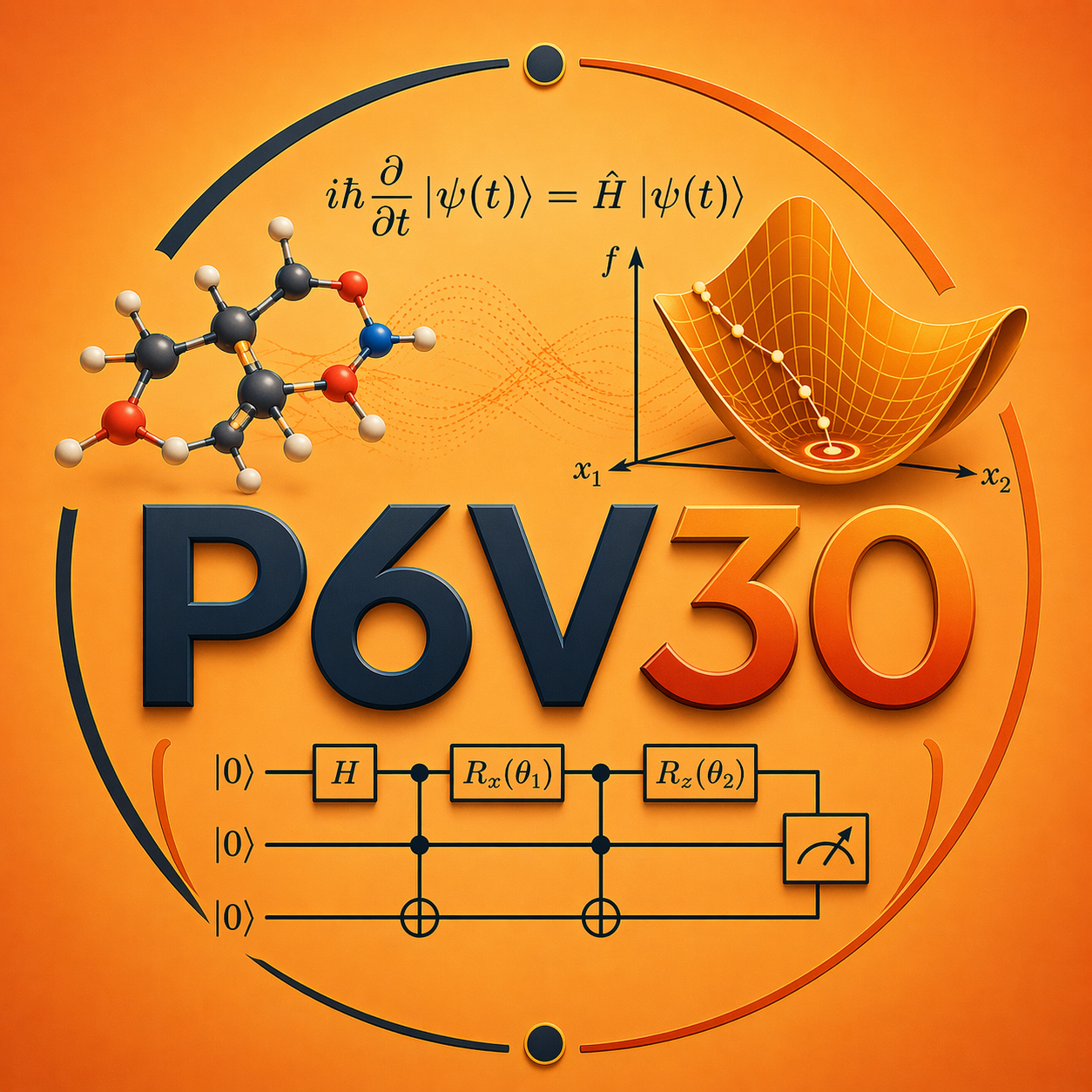
P6V30 Research Programme
Constraint-Induced Topological Barriers in Electronic Structure and Optimization
A six-pillar research programme (2025–2030) developing a unified geometric framework in which physically motivated constraints produce fibre bundle structures, and topological barriers govern transitions between symmetry-inequivalent states in quantum chemistry, optimization, and machine learning.
Research Areas
Topological Methods in Quantum Chemistry
Symmetry-Induced Topological Barriers, Lie Algebra Frameworks, and Symmetry-Breaking Transitions in Molecular Electronic Structure.
Quantum Computing Algorithms
Wavefunction Ansatz Design for NISQ Hardware, Quantum Phase Estimation, and Circuit-Based Electronic Structure Simulation.
Mathematical Optimization
Geometry-Driven Trust-Region Methods, Singular Set Detection, and Basin Traversal Algorithms grounded in Inverse Function Theory.
Ayurveda Prakriti and Inflammaging
Prakriti-Based Phenotypic Stratification as a Marker for Inflammaging Susceptibility, quantified via Genomic Inflammatory Indices.
Experience & Education
Academic Positions
- Associate Professor — Chanakya University 2024–2025
- Assistant Professor — SRM University-AP 2022–2024
- Assistant Professor — GITAM University 2017–2019
Education
- MSc Mathematics — Umeå University ongoing
- Postdoctoral Research — Linnaeus University 2019–2021
- PhD — Linköping University 2012–2016
- MSc Chemistry — IIT Guwahati 2008–2010
- BSc — Acharya Nagarjuna University 2004–2007
Publications
Full publication list and citation metrics available on Google Scholar.
Google Scholar Profile